
Cleanroom Maintenance: Complete Guide to Daily, Periodic & Annual Upkeep in Compliance with GMP & ISO 14644
- On 2026-03-25 15:52:10
- By OCCR
In industries with stringent environmental cleanliness requirements such as pharmaceutical manufacturing, electronic chip production, and bioengineering, cleanrooms serve as the core fortress safeguarding production quality and research precision. Key indicators including cleanliness class, airflow stability, and temperature and humidity control directly determine product pass rates and experimental reliability. However, cleanroom cleanliness is not a one-time achievement; long-term stability relies on scientific and systematic maintenance. Combining industry standards such as GMP and ISO 14644, this article breaks down the core logic and practical methods of cleanroom maintenance from three dimensions: daily inspection, periodic maintenance, and specialized upkeep.
I. Prerequisite: Why Cleanroom Maintenance Cannot Tolerate Any Negligence?
The core value of a cleanroom is to control airborne particles, microorganisms, harmful gases, and other pollutants to extremely low levels through air filtration, airflow organization, and environmental control technologies. As operation time passes, filters accumulate dust, equipment wears out, and personnel operations may introduce contamination. Improper maintenance will not only reduce cleanliness class, leading to product scrappage and experimental failures, but also shorten equipment service life and increase later renovation costs. For example, in the pharmaceutical industry, excessive microorganisms in a cleanroom may result in entire batches of drugs being rejected; in the electronics industry, tiny dust particles can cause chip short circuits, directly lowering product yield. Therefore, maintenance is essentially preventive protection, not post-fault repair.
II. Daily Maintenance: The Fundamental Daily Defense Line (Performed Daily/Per Shift)
Daily maintenance is the first line of defense against cleanroom contamination. It must be implemented for every shift and every entrant to form standardized operating habits.
1. Personnel and Materials: Strict Control of Pollution Sources
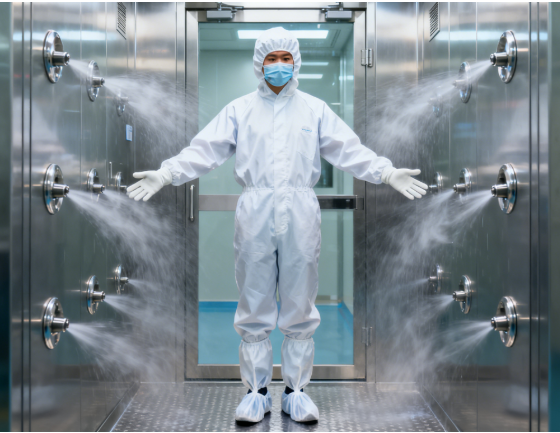
Personnel and materials are the primary external contamination sources for cleanrooms, with control centered on isolation and purification. Before entering, personnel must complete the regulated gowning procedure: remove personal clothing in the changing room and put on dedicated garments; then enter the airlock to sequentially don cleanroom suits, sterile masks, latex gloves, and clean shoe covers, ensuring full coverage of hair, skin, and clothing with no exposed areas. After gowning, personnel must pass through an air shower for 15–30 seconds of high-velocity air dust removal to eliminate surface-borne floating dust. Carrying mobile phones, cosmetics, tissues, and other unrelated items is strictly prohibited. Tools required for work must be disinfected with alcohol and placed in dedicated clean toolboxes before entry.
Material management also follows the purified access principle: all materials must be disinfected via pass-through boxes or air showers before transfer; outer packaging must be removed in non-clean areas, with only inner clean packaging allowed into clean zones. Production waste must be placed in dedicated sealed bags and promptly removed after each shift to prevent accumulation and bacterial growth. Meanwhile, a personnel and material entry-exit log must be established to record the number of entrants, material names, and entry-exit times per shift, providing a basis for contamination traceability.
2. Environmental Parameters: Dynamic Balance Through Real-Time Monitoring
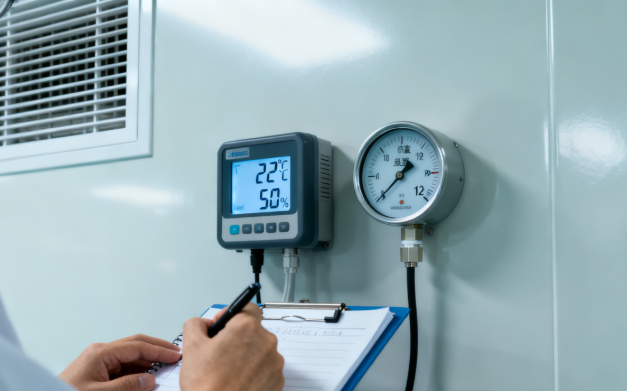
Temperature, humidity, and pressure differentials are core indicators of cleanroom environmental stability and must be regularly monitored and maintained within appropriate ranges. Operators must record temperature, humidity, and pressure differential data every 2–4 hours. Any deviations require immediate troubleshooting: pressure drop may stem from clogged filters or insufficient supply air volume, while abnormal temperature and humidity call for inspection of the dehumidification and heating modules of the air conditioning system. Additionally, airflow conditions at supply and return air vents must be observed daily to ensure no obstructions, abnormal noise, or visible dust accumulation on return air grilles.
3. Basic Cleaning and Equipment Inspection: Contamination Removal in Details
Daily cleaning shall use cleanroom wipes dampened with dedicated cleanroom detergents to wipe floors, equipment surfaces, and workstations, focusing on dust-prone corners and gaps to avoid fiber residue. Cleaning shall follow the principle of from inside to outside, top to bottom to prevent secondary contamination. For equipment inspection, priority shall be given to the operating status of the Heating, Ventilation, and Air Conditioning (HVAC) system and Fan Filter Units (FFUs), verifying normal indicator lights, no abnormal noise or vibration. The operating duration of UV disinfection lamps and ozone generators shall be checked to ensure daily disinfection lasts no less than 30 minutes, with sufficient ventilation afterward to avoid disinfectant residue harming personnel and products.
III. Periodic Maintenance: Periodic Deepened Protection System (Performed Weekly/Monthly/Quarterly)
If daily maintenance is "surface protection," periodic maintenance is "deep reinforcement," requiring targeted inspection and upkeep of core equipment and key systems to prevent minor issues from escalating into major failures.
1. Air Filtration System: Key Maintenance of the Cleanliness Core
The air filtration system is the "heart" of a cleanroom, consisting of primary, medium, and high-efficiency (HEPA/ULPA) filters. Maintenance quality directly determines cleanliness class, requiring a hierarchical management mechanism due to distinct cycles and methods for different filters.
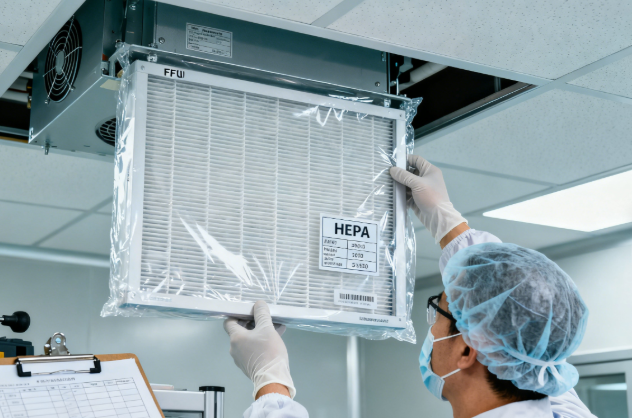
Notably, after replacing high-efficiency filters, the cleanroom must undergo full self-purification (usually 30–60 minutes) and resume production or experiments only after particle counter testing meets standards. Filter replacement shall record model, replacement time, operator, and other details to form a complete filter lifecycle file.
| Filter Type | Maintenance Cycle | Core Operation Content | Replacement Judgment Standard |
|---|---|---|---|
| Primary Filter | Weekly cleaning Replaced every 1-3 months | Disassemble → rinse with clean water → dry and reinstall Avoid direct sunlight | Surface with obvious dirt or air permeability drop |
| Medium-Efficiency Filter | Monthly inspection Replaced every 3-6 months | Backflush with compressed air (pressure ≤0.3MPa) → remove dust | Resistance reaches 1.5 times the initial value Or damaged |
| High-Efficiency Filter | Quarterly inspection Replaced every 1-2 years | Detect filtration efficiency with particle counter Wear non-woven gloves when replacing Avoid touching filter material | Non-compliance with cleanliness standard Or resistance exceeds 2 times the initial value |
2. Enhanced Cleaning and Disinfection: All-Round Contamination Elimination
Periodic cleaning goes beyond daily scope to achieve full coverage, no dead ends. Weekly wet mopping of floors shall use dedicated cleanroom mops, classified by cleanroom class to avoid cross-use. Monthly deep cleaning of walls, ceilings, and high-efficiency supply air louvers may use long-handled dust-free brushes to remove high-level dust, followed by wiping with cleanroom wipes. For disinfection, comprehensive sanitization shall be performed monthly using a dual method of UV irradiation + ozone disinfection: UV lamps shall cover all areas with irradiation time ≥60 minutes; ozone disinfection shall reach a concentration of 0.3–0.5 mg/m³, with ventilation for over 2 hours afterward to ensure residual ozone is below 0.1 mg/m³.
Cleaning tool management is equally critical: dust-free wipes and mops must be regularly sterilized (e.g., high-temperature or ethylene oxide sterilization) and stored in dedicated clean containers to prevent tools from becoming contamination sources.
3. In-Depth Equipment Inspection: Precise Control of Operational Stability
Monthly specialized FFU inspection shall cover motor speed, filter sealing, and dust removal from fan impellers to ensure uniform and stable airflow. Condensate drain lines of air conditioning systems shall be inspected for unobstructed flow to prevent bacterial growth. Quarterly calibration of monitoring equipment including pressure gauges, temperature and humidity sensors, and particle counters shall be conducted by third-party agencies or standard calibration instruments to ensure data accuracy. Furthermore, cleanroom door and window sealing strips shall be inspected and replaced promptly if aged, loose, or damaged to prevent external contaminated air infiltration. Air shower interlock devices shall be checked to ensure dual doors cannot open simultaneously, avoiding airflow short-circuiting.
IV. Specialized Upkeep: Annual Systematic Optimization (Performed Annually/During Overhaul)
Specialized upkeep serves as an annual physical examination for cleanrooms, involving comprehensive testing and system optimization in line with industry specifications and equipment conditions to ensure long-term stable operation.
1. Comprehensive Cleanroom Validation: Authoritative Compliance Assurance
Annually, a qualified third-party testing agency shall be entrusted to conduct cleanliness class testing per ISO 14644, covering core items: airborne particle count (verifying particle concentration compliance), sedimentation/airborne microorganism testing (controlling microbial contamination), airflow pattern testing (ensuring rational airflow organization), and surface cleanliness testing (checking contaminant residue on equipment and walls). A formal test report shall be obtained upon completion. For non-compliant results, root causes (e.g., filter failure, poor sealing, non-standard personnel operations) shall be identified immediately, with targeted rectification plans implemented until re-testing passes.
2. System Maintenance and Component Replacement: Equipment Lifespan Extension
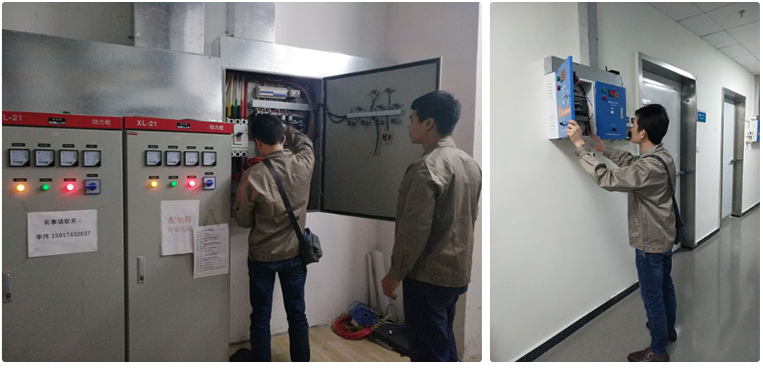
Annual comprehensive HVAC system maintenance shall include descaling cooling towers and condensers to improve heat exchange efficiency; lubricating fan bearings and motors, inspecting belt tension, and replacing aged belts; cleaning dust in air ducts to prevent duct contamination from affecting air quality. Meanwhile, cleanroom floors, walls, and ceilings shall be inspected, with timely repair or replacement for issues such as epoxy floor cracking, wall dusting, or ceiling detachment. For electrical systems, insulation testing and dust removal shall be performed on lighting and control cabinets, eliminating hidden dangers of line aging to ensure electrical safety.
V. Core Management: Key Measures for Effective Maintenance Implementation
Scientific maintenance requires not only technical methods but also a sound management system to avoid unclear responsibilities and inadequate execution.
First, establish a maintenance log system to record maintenance time, content, personnel, replacement part models, testing data, and other details, forming traceable maintenance files to analyze equipment operation patterns and predict failures in advance. Second, strengthen personnel training: maintenance staff must be professionally trained and certified before taking post, proficient in cleanroom operating principles, maintenance specifications, and emergency response procedures to prevent contamination or equipment damage from improper operation. Finally, develop emergency response plans for incidents such as sudden power outages, filter damage, and cleanliness exceedance, clarifying handling processes and responsible personnel to ensure rapid response, timely resolution, and minimal losses.
VI. Industry-Specific Requirements: Precise Matching to Scenario Needs
Cleanroom maintenance priorities vary by industry based on operational characteristics. Pharmaceutical/biopharmaceutical cleanrooms require extra focus on sterile environment maintenance with higher disinfection frequency (e.g., daily ozone disinfection), strict adherence to GMP during maintenance to avoid cross-contamination, and enhanced analysis of microbial testing data. Electronics industry cleanrooms prioritize static electricity and particulate control, requiring anti-static flooring and tools to prevent chip damage from static electricity, plus regular static grounding resistance testing. Food processing cleanrooms emphasize pest control, with regular inspection of insect screens and light traps, and use of food-grade disinfectants to prevent chemical residue.
In summary, cleanroom maintenance is a normalized, refined, and systematic task with no one-time solution, only a sense of responsibility for consistent adherence. From daily personnel control to annual system overhauls, no step can tolerate negligence. Only by integrating technical methods with a management system can cleanrooms maintain stable cleanliness at all times, building a solid "clean barrier" for production and scientific research.
Related Articles
-
BPOM Cleanroom Requirements for Pharmaceutical Plants in Indonesia
-
Core Technical Essentials of CleanRoom Design and Operation
-
Cleanroom HVAC System Design for Hospital Operating Theatres
-
Grand Construction Kick-off Ceremony Held for Sari Roti Bakery Cleanroom Project
-
BPOM Cleanroom Requirements for Pharmaceutical Plants in Indonesia
-
What Parameters Need to Be Controlled in Cleanrooms & Relevant ISO Standard Specifications
-
Cleanroom ISO Classification Differences
-
BPOM Cleanroom Requirements for Pharmaceutical Plants in Indonesia
-
Core Technical Essentials of CleanRoom Design and Operation
-
Cleanroom HVAC System Design for Hospital Operating Theatres
-
Grand Construction Kick-off Ceremony Held for Sari Roti Bakery Cleanroom Project
-
Cleanroom HVAC System Design for Hospital Operating Theatres